Value that endures. Value that grows.
There is an asset class you can hear.
A few thousand instruments worldwide. Their makers have been dead for two hundred years.
A tangible asset that improves when someone uses it.
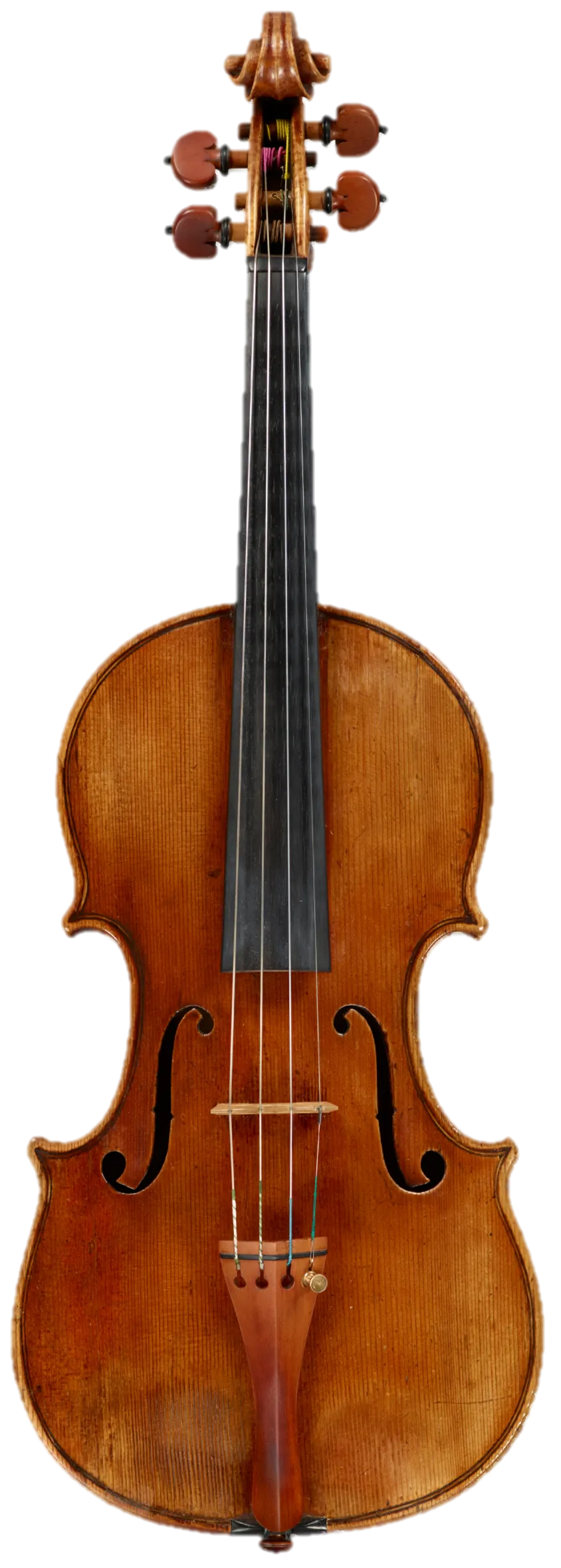
Stringed instruments as an asset class
An instrument from an eighteenth-century Cremonese workshop has had twelve to twenty owners before it reaches you. It will have more after it leaves you.
In between, someone plays it. Not occasionally — daily, for hours. Because that is precisely what the instrument needs in order to remain what it is.
No other tangible asset behaves this way. A car loses value when it is driven. A watch loses value when it is worn. A stringed instrument loses value when it lies still.
Foundation
- 2014 founded in Frankfurt am Main
- from EUR 150,000 entry into investment-grade historic instruments
- since 1907 the Fuchs-Taxe has documented sale prices in this market
The Frankfurter Allgemeine Zeitung reported in February 2018 that the seventeenth edition of Albert Fuchs’s Taxe der Streichinstrumente shows an average annual appreciation of between 5 and 8 per cent, based on sale prices recorded since the first edition of 1907.
The Fuchs-Taxe has appeared at intervals of several years since 1907 and records prices actually achieved. It is neither an estimate nor a forecast, but a compilation of what was paid.
Past performance is not a reliable indicator of future results. The value of investments and any income from them is not guaranteed and may fall as well as rise. Investors may not recover the full amount invested.
Five characteristics that do not otherwise occur together
The market is small. Worldwide, only a few thousand instruments qualify as investments at all. Supply cannot be increased — the workshops whose work defines the top of the market closed two hundred years ago.
-
A value that does not sit on a screen.
An instrument has a workshop, a year of making and a name. Its value is not re-quoted by the minute but established at intervals of years by expert appraisal.
-
Low correlation.
Development runs largely independently of equities, bonds and property. Even in the autumn of 2008 this market remained calm.
-
Mobile and without a location.
Unlike property, an instrument can be kept where you wish and transferred when you wish. Running costs remain modest.
-
A good that is becoming scarcer.
Instruments are lost, damaged, absorbed into institutions. No new ones appear. Global demand meets a supply that is shrinking.
-
A second return.
It cannot be quantified. See Block 07.
What does not appear in a catalogue
Historic master instruments are rarely offered publicly. They pass between collectors, foundations, dealing houses and musicians — usually without any advertisement. Anyone outside that circle does not learn of a sale.
That is precisely our function. We see instruments before they have a price.
What you can acquire through VIOLIN ASSETS you would not have found on an open market — because it was never offered there.
Six grades. Only from the fourth do we discuss an investment.
Not every old instrument is an investment. The VIOLIN ASSETS certified seal grades maker, condition, tone, year of making and playing history across six levels from 1aaa to 3. Only from grade 1b does an instrument qualify as an investment.
And the principle that distinguishes us from dealers
VIOLIN ASSETS does not appraise instruments itself. Every expert opinion is commissioned from independent authorities whose judgement is recognised internationally. Anyone who places instruments and also values them holds a conflict of interest. We do not.
What is examined
- Certificate of authenticity from an internationally recognised authority
- Dendrochronological dating of the timber
- Computed tomography and radiography to assess substance and earlier intervention
- Evidenced provenance: origin, attribution, restoration work, playing history
The greatest risk in this market is forgery. This process is the answer to it.
The evening your instrument plays
At some point you will sit in a concert hall. On stage a musician you know is playing — because the instrument in her hands is yours.
What happens in that moment appears in no statement. It is the reason people choose this asset class rather than another with comparable figures.
Every instrument placed through VIOLIN ASSETS is currently on loan. None is in a vault. The musicians pay no fee for the loan; they cover the annual insurance premium.
And one thing more: an eighteenth-century instrument that is played and cared for survives. One that is forgotten does not. Whoever owns one holds a piece of European musical history — and has a say in whether it still exists in a hundred years.
Video module: Manuel Lipstein — on receiving a historic instrument on loan (2:04) — not yet embedded; name clearance and the edit are still outstanding.
Owning a master instrument should never become work
An instrument requires insurance, climate control, half-yearly inspection, documentation, a loan agreement and someone to accompany the musician. None of that is your task.
-
Selection
We survey the market, including instruments not publicly offered, and present a selection — each with complete documentation.
-
Authentication
External expert opinions, dendrochronology, computed tomography. See Block 06.
-
Administration
Insurance, inspection, documentation, loan agreement, annual reporting on condition, the musician’s progress and valuation.
What you should know before we speak
There is no asset class without risk. Anyone who tells you otherwise is selling you something.
-
Liquidity.
This market is not unlimitedly liquid. A sale can take twelve months, in some cases longer. Anyone who must sell at short notice sells worse.
-
Time horizon.
Five to ten years is the minimum; ten or more is sensible. Below that, the asset class does not work.
-
Forgery.
The greatest risk in the market. Examination reduces it substantially but not to zero.
-
Valuation.
Value is established by appraisal, not by an exchange. Between two appraisals there is no daily price.
-
Concentration.
We recommend a share of no more than about ten per cent of total assets.
Ten to twenty instruments a year
That is not a capacity limit. It is a decision.
Each instrument is examined individually, insured individually, placed individually and supervised individually throughout the holding period. That cannot be accelerated without the examination suffering.
We therefore speak with few investors each year. But at length.
What has been written
- Handelsblatt
- Frankfurter Allgemeine Zeitung
- Frankfurter Allgemeine Sonntagszeitung
- WirtschaftsWoche
- Börsen-Zeitung
- boerse.ARD.de
- private banking magazin
- Fuchs-Briefe
- Kurier
Speaking to Handelsblatt in September 2023, Christian Reister described the market as small, with only a few thousand instruments worldwide suitable as investments.
For its chart on the appreciation of historic violins, Handelsblatt cited VIOLIN ASSETS and the Fuchs-Taxe as sources.
Who is behind this
Christian Reister founded VIOLIN ASSETS in 2014. He previously worked in institutional asset management at Bankhaus Metzler in Frankfurt am Main.
The company is based at Opernplatz, in the heart of Frankfurt’s financial district.
A conversation without obligation
An investment in stringed instruments begins with a conversation about your objectives: time horizon, volume, cultural interest. Whether a loan to a musician is intended. Whether the instrument should one day remain in the family.
We respond within two working days. Whatever you tell us is treated in confidence.